UPV Test Calculator — Ultrasonic Pulse Velocity
Ultrasonic pulse velocity calculator — velocity from path length and transit time, with IS 516 (Part 5/Sec 1):2018 Amd 1 quality grading.
UPV Test Calculator — Velocity & Crack Depth
Ultrasonic pulse velocity from path length and transit time, graded per IS 516 (Part 5/Sec 1):2018 Table 1 as substituted by Amendment 1 (November 2019), grade-dependent criteria for ≤ M25 and > M25 concrete, plus surface-crack depth by the transit-time method. Apply the instrument zero correction before entering readings.
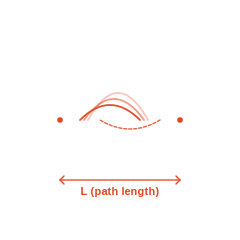
Velocity & quality grade
Direct transmission preferred; note the arrangement used (direct / semi-direct / indirect).
After zero correction from the calibration bar.
Amendment 1 (Nov 2019) sets tighter velocity criteria for grades above M25.
Pulse velocity
km/s
Doubtful quality. Additional tests are necessary per the Table 1 footnote.
Surface crack depth (transit-time method)
Same spacing L for both readings: t₁ on sound concrete, t₂ straddling the crack, transducers equidistant from it.
Estimated crack depth
mm
- Sound velocity at L
- km/s
How this is calculated
Velocity = path length ÷ transit time; in mm and microseconds the quotient is directly km/s. Quality grading follows IS 516 (Part 5/Sec 1):2018 Table 1 (clause 2.5.2) as substituted by Amendment 1 (November 2019), applied to the average pulse velocity by cross probing: for concrete up to and including M25: above 4.5 Excellent, 3.5–4.5 Good, below 3.5 Doubtful; for concrete above M25: above 4.50 Excellent, 3.75–4.50 Good, below 3.75 Doubtful (km/s). A “Doubtful” grading calls for additional tests (Table 1 footnote), and Table 1 shall not be used to estimate concrete grade from velocity (clause 2.5.2).
Crack depth uses the transit-time method of BS 1881 Part 203 practice: d = (L/2) × √((t₂/t₁)² − 1). This formula is not an IS-code provision, and it assumes an open, perpendicular crack in homogeneous concrete.
Worked example
Velocity: 500 mm direct path, corrected time 105 µs → 500/105 = 4.76 km/s → Excellent in both grade groups. At 3.70 km/s the split shows: Good for ≤ M25, Doubtful for > M25.
Crack depth: L = 300 mm, t₁ = 68.2 µs on sound concrete (v = 4.4 km/s), t₂ = 84.9 µs straddling the crack.
d = 150 × √((84.9/68.2)² − 1) = 150 × 0.742 = ≈111 mm
FAQ
What is a good pulse velocity value?
Per IS 516 (Part 5/Sec 1):2018 Table 1 as substituted by Amendment 1 (Nov 2019), applied to the average cross-probing velocity: ≤ M25: >4.5 km/s Excellent · 3.5–4.5 Good · <3.5 Doubtful; > M25: >4.50 Excellent · 3.75–4.50 Good · <3.75 Doubtful. The grade reflects density and homogeneity: good concrete, well compacted, no honeycombing. It does not read strength directly; correlate with cubes or cores for that. A Doubtful grade requires additional tests.
Does a higher velocity mean higher strength?
Broadly correlated, but not reliably convertible. Moisture, age, aggregate type and temperature all shift velocity without the same shift in strength. That is why IS 516 (Part 5/Sec 1):2018 grades quality, not grade of concrete. Use UPV for uniformity mapping across a member and spot-check anomalies with cores.
Which transducer arrangement should I use?
Direct (opposite faces) gives the truest path and is preferred. Semi-direct (adjacent faces) is acceptable; indirect (same surface) under-reads velocity by roughly 5–10% and is mainly used for crack depth and surface-layer surveys. Note the arrangement with every reading.
When does the crack-depth method fail?
When the crack is not open (tight or water-filled: no delay to measure, t₂ ≤ t₁), not perpendicular to the surface, when reinforcement lies between the transducers, or when the depth approaches the spacing. Treat the result as an estimate to confirm, not a measurement.
Calculator companions
Often used together with this calculator. Pick the next step in your design or QA loop.
Visualisation
Grade bands per IS 516 (Part 5/Sec 1):2018 Table 1 incl. Amendment 1 (Nov 2019), average pulse velocity by cross probing: first value ≤ M25, second > M25 (km/s).
This is the same calculator ConcreteInfo publishes on the main site. It runs in your browser, with no account and nothing to install.