CI-SW · Software catalogue
Engineering software for construction, issued like a drawing set
Fourteen products for the lab, the plant, the site and the office — mix design to IS 10262, cube statistics to IS 456, ERP for the ready-mix floor, and twenty-three calculators that run in this page with no account.
- Sheets
- 14
- Disciplines
- 6
- Revision
- REV A
CI-SW · Rev A · 29/11/2026 · issued for construction
CI-D-01 … CI-D-06
The six faces of the specimen
Every product is filed under the discipline it belongs to. The cube on this page carries the same six faces.
Lab & Testing
CI-D-01LIMS, QA/QC and audit software for concrete laboratories, plants and sites.
4 products →Plant & Production
CI-D-02Admixture formulation, precast lifecycle and production-floor software.
2 products →Enterprise Systems
CI-D-03ERP for ready-mix concrete, dry mix products and construction.
3 products →Engineering Tools
CI-D-04Free calculators, mix design helpers and the IS 456 clause finder.
2 products →Open Source
CI-D-05Open-source tools we publish for the wider engineering community.
2 products →Platform
CI-D-06The licensing and activation server every ConcreteInfo app depends on.
1 product →CI-SW-010 · CI-SW-011
Use it now, on this page
Four of the twenty-three calculators, set into the page rather than framed. No account, no install, no email address.
Mix Design Report Generator
A complete IS 10262:2019 worked report. Target strength (Cl 4.2), durability ceiling (IS 456 Table 5), water (Table 4), cementitious split, aggregate volumes (Table 5) and the Cl 5.8 trial plan. Filled with your project data and printable as a submission-ready PDF. Constants verified against the BIS controlled copy.
Inputs
Date:
| Step | Computation | Reference |
|---|---|---|
Site/QC engineer
Mix designer
QC head / Client
Calculator companions
Often used together with this calculator. Pick the next step in your design or QA loop.
Cube Test Statistics & Acceptance
Enter your 28-day cube results and grade. Get mean, standard deviation, CV and the full IS 456:2000 Table 11 (Amendment 4) conformity verdict: groups of four, individual limits, and small-pour criteria.
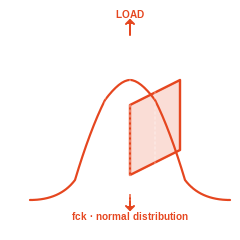
Comma, space or newline separated. Groups of four are taken consecutively from the top.
IS 456 Table 11 verdict
- Results / mean / σ
- / / N/mm²
- Coefficient of variation
- %
- σ used
- ()
- Group-of-4 mean limit
- ≥
- Individual limit
- ≥
- Group means
How this is calculated
Mean and sample standard deviation (σ, n−1 basis) come straight from your numbers. Acceptance follows IS 456:2000 Table 11 as amended through Amendment 4: each group of four non-overlapping consecutive results must average at least fck + max(0.825σ rounded to the nearest 0.5, 3), and every individual result must be at least fck − 3. For pours of 30 m³ or less with fewer than four samples, Note 2 applies: mean ≥ fck + 4 and individual ≥ fck − 2.
The σ used is your established value if entered; otherwise the assumed values of Table 8 apply, 3.5 (M10–M15), 4.0 (M20–M25), 5.0 (M30+) N/mm², which the code permits until a site σ from 30+ results is established.
Worked example
Given: M25, results 34, 36, 38, 33 N/mm² (one group of four), no established σ → Table 8 σ = 4.0.
Mean = 35.25; sample σ = 2.22; CV = 6.3%
Group limit = 25 + max(round½(0.825 × 4.0), 3) = 25 + max(3.5, 3) = 28.5 → 35.25 ≥ 28.5 ✓
Individual limit = 25 − 3 = 22 → minimum 33 ≥ 22 ✓ → conforms
FAQ
Why a group of four, and in what order?
IS 456 judges conformity on the mean of four non-overlapping consecutive results. Consecutive in order of sampling, so the check tracks production over time, not a hand-picked set. Enter results in the order the cubes were cast; this tool slices them into groups of four from the top.
When can I stop using the assumed standard deviation?
Once you hold 30 or more results for the grade and plant, compute the actual σ and enter it: a well-controlled plant typically shows σ of 2–4 N/mm², comfortably below the assumed 4.0–5.0, which relaxes the group-mean limit and rewards good control.
My pour was only 22 m³ and I have 2 results — which limits apply?
Table 11 Note 2: for concrete quantity up to 30 m³ where fewer than four samples are taken, the mean must be at least fck + 4 and each individual result at least fck − 2. Tick the small-pour box to apply these limits. A single sample must itself be at least fck + 4.
What happens when a result fails?
A failed Table 11 check does not automatically mean rejection: IS 456 Cl 16.4 permits investigation of the actual structure — typically non-destructive testing (UPV, rebound hammer) or core extraction per IS 516 Part 4 / IS 456 Cl 17. The failure report should trigger an investigation of batching, sampling and testing before any removal decision.
Calculator companions
Often used together with this calculator. Pick the next step in your design or QA loop.
Visualisation
Nominal Mix Concrete Calculator (M5–M20)
Material quantities per IS 456:2000Table 9. Shown in the code's actual mass basis, alongside the conventional 1:2:4-style equivalents sites have batched for decades.

Route 1:
bags cement
- Cement
- kg
- Fine aggregate
- kg
- Coarse aggregate
- kg
- Water — maximum
- litres
Route 2:
bags ·
- Sand
- m³
- Sand to batch (moist, bulking-corrected)
- m³
- Coarse aggregate
- m³
How this is calculated — and why two answers
IS 456 Table 9 prescribes nominal mixes by mass: total dry aggregate per 50 kg of cement (M5: 800 kg → M20: 250 kg), fine-to-coarse aggregate 1:2 by mass (adjust 1:1½–1:2½ for grading and MSA), and a maximum water content per 50 kg (60 L at M5 down to 30 L at M20). Route 1 converts that batch to per-m³ quantities by absolute volume (cement 3.15, aggregate 2.65 specific gravity).
Route 2 converts the familiar 1:5:10 … 1:1½:3 ratios with the usual 1.54 dry-volume factor. For M5–M10 the two agree closely. For M15 and M20 the conventional ratios run noticeably richer in cement than Table 9: a real divergence you should know about when comparing estimates. We show both rather than quietly pick one.
Verified against IS 456:2000 (AMD 5): see our verified constants table.
Worked example
Given: M20, 1 m³, FA:CA 1:2.
Route 1 (Table 9): one batch = 50 kg cement + 250 kg agg + 30 L water → 0.140 m³ → per m³: 357 kg cement (7.1 bags), FA 594 kg, CA 1189 kg, water ≤ 214 L.
Route 2 (1:1½:3): dry 1.54 m³ → cement 0.28 m³ = 8.1 bags, sand 0.42 m³, CA 0.84 m³.
FAQ
Why can't I select M25 or higher?
IS 456 Cl 9.3 permits nominal (recipe) mixes only up to M20, and only for minor plain works. M25+ needs a designed mix proportioned per IS 10262:2019 for your actual materials, that is what the CMD App does.
Is nominal mix allowed for RCC?
In principle IS 456 restricts nominal mixes to plain concrete minor works. Design mixes are preferred for everything structural; site-batched 1:1½:3 "M20" for RCC is a legacy practice, not a code endorsement.
Why does Route 2 need more cement than Table 9 for M20?
The 1:1½:3 ratio descends from old volume-batched recipes and, converted by mass, sits at about 400 kg/m³ cement versus Table 9's roughly 300 kg/m³. Table 9 is the code's prescription; the ratio is the tradition. For structural work neither replaces a designed mix.
Calculator companions
Often used together with this calculator. Pick the next step in your design or QA loop.
Visualisation
BBS Cutting Length Calculator
Cutting lengths and steel weights for bar bending schedules per IS 2502:1963, stirrups, seismic stirrups (IS 13920), hooked bars — with the method stated for every result.
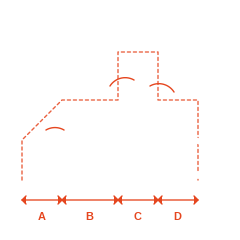
Cutting length per bar
mm
order length mm (next whole 25, Cl 5.1.1)
- Unit weight
- kg/m
- Weight per bar
- kg
- Total ( bars)
- kg
Method:
How this is calculated
Unit weight: ز/162 kg/m: the nominal mass basis (7850 kg/m³ steel). Actual delivered weight varies with rolling tolerance; our rolling margin calculator covers that check.
Stirrups: IS 2502 Table VIII gives the rectangular stirrup cutting length directly as 2(A+E) + 24d from the scheduled external dimensions. For ductile-detailing zones, IS 13920 Cl 8.1(b) requires 135° hooks with a straight extension of 10d (≥ 75 mm): the seismic option adds 2 × max(10d, 75) to the stirrup body, the standard site convention for that case.
Hooks and bends: IS 2502 Table II adds an allowance to scheduled dimensions per hook (H = 9d / 11d / 13d / 17d for steel factor k = 2 / 3 / 4 / 6) and per bend (B = 5d – 7d), each rounded to 5 mm with a 75 mm minimum. IS 2502 Cl 3.8 separately requires the straight portion beyond a stirrup's end curve to be at least 8d.
Verified against the IS 2502:1963 BIS PDF: see our verified constants table.
Why you may see different answers elsewhere
Most BBS tutorials tell you to deduct 2d per 90° bend and 3d per 135° bend. That shortcut belongs to the centerline-measurement convention. You measure leg lengths along the bar's centreline and subtract the bend geometry. It is not in IS 2502. The code instead works from scheduled external dimensions and adds Table II allowances. Both conventions produce sensible numbers; they just must not be mixed. This calculator uses the IS 2502 method for code shapes and says so on every result card.
Worked example
Given: column stirrup for a 300×450 member with 40 mm cover → A = 220, E = 370 (external), Ø8, 25 nos.
IS 2502 Table VIII: cutting = 2(220+370) + 24×8 = 1180 + 192 = 1372 mm → order 1375 mm
Weight = 0.395 kg/m × 1.372 m = 0.54 kg per bar → 13.5 kg for 25 stirrups
Seismic variant: 2(590) + 2×80 = 1340 mm (135° hooks, 10Ø = 80 ≥ 75 mm extensions)
FAQ
What is the deduction for a 90° bend?
Under the popular centerline convention: 2d. Under IS 2502's allowance method: there is no deduction. You add Table II allowances to external dimensions instead. Pick one convention per schedule and stay with it; this tool uses IS 2502.
Which hook do stirrups need in seismic zones?
135° hooks with a 10d (≥75 mm) straight extension into the confined core (IS 13920). A 90° hook straightens when cover spalls in an earthquake. Exactly when the stirrup must hold.
Why ز/162 for unit weight?
Mass = π/4 × Ø² × 7850 kg/m³ = 0.00617 ز ≈ ز/162. It is the nominal cross-section value; rolling tolerance means delivered weight differs, which is what the rolling margin check is for.
Calculator companions
Often used together with this calculator. Pick the next step in your design or QA loop.
Visualisation
All twenty-three calculators live under /tools/.
The codes
Built to the code, not around it
The software in this catalogue implements the Indian and American standards the work is done to. Each product sheet lists the codes it carries.
- ACI 211.1
- IS 10262
- IS 10262:2019
- IS 1199
- IS 1786
- IS 2386
- IS 2502
- IS 383
- IS 4031
- IS 456
- IS 456:2000
- IS 516
Enquiry
Talk to the people who built it
Tell us what you work on and someone will come back with what runs on it.