Rebar Weight Calculator — TMT Steel Weight Per Metre
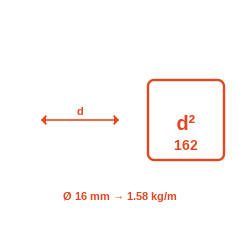
Steel weight from bar diameter: a 12 mm TMT bar weighs 0.888 kg/m on the IS 1786 nominal-mass basis (d squared / 162.2, density 7850 kg/m3).
Rebar Weight Calculator
Weight of TMT reinforcement from bar diameter: the IS 1786 nominal-mass basis (d²/162.2 from a steel density of 7850 kg/m³). Enter diameter, cut length and number of bars.
Common TMT: 8, 10, 12, 16, 20, 25, 32 mm
IS 1786 nominal mass (kg/m)
| 8 mm | 0.395 |
| 10 mm | 0.617 |
| 12 mm | 0.888 |
| 16 mm | 1.578 |
| 20 mm | 2.466 |
| 25 mm | 3.854 |
| 32 mm | 6.316 |
Steel weight
kg ( t)
- Unit weight
- kg/m
- Weight per bar
- kg
- Bars computed
- nos
How this is calculated
Mass per metre is the bar’s cross-section times the density of steel: (π/4) d² × 7850 kg/m³. With d in millimetres this collapses to d²/162.2 kg/m: the nominal-mass basis of IS 1786:2008 (12 mm → 0.888 kg/m, 16 mm → 1.578 kg/m, matching the standard’s table). Total weight is unit weight × cut length × number of bars.
The figure is nominal: IS 1786 permits small mass tolerances on individual bars and batches, so a weighbridge will differ slightly. Order procurement on the nominal figure and reconcile tolerance-band deviations with the supplier.
Worked example
Given: a beam needs 100 nos of 12 mm bars, each cut to 12 m.
Unit weight = 12²/162.2 = 0.888 kg/m
Weight per bar = 0.888 × 12 = 10.65 kg
Total = 10.65 × 100 = 1,065 kg ≈ 1.07 tonnes, before laps and wastage, which your bar bending schedule (see the BBS calculator) adds separately.
FAQ
Why divide d squared by 162.2?
Mass per metre = cross-section area x density = (π/4)d² x 7850 kg/m³. Working in mm and kg, that collapses to d²/162.2. 12 mm gives 144/162.2 = 0.888 kg/m, exactly the nominal mass in IS 1786:2008.
Does Fe500 or Fe550D bar weigh more than Fe415?
No. The nominal mass depends only on the nominal diameter and the 7850 kg/m³ steel density, which are the same for every grade. Strength grade changes the stress the bar carries, not its weight.
Why does the weighbridge reading differ slightly from this calculation?
IS 1786 permits small mass tolerances on individual bars and batches against the nominal mass, and rolled bars vary within them. Order and reconcile steel on the nominal figure; investigate only deviations beyond the standard’s tolerance.
Do the ribs and lugs on TMT add weight?
The nominal mass is defined on the nominal diameter, and the rib geometry is controlled so the mass stays within the standard’s tolerance. No rib allowance is added in bar-by-bar estimates.
Calculator companions
Often used together with this calculator. Pick the next step in your design or QA loop.
Visualisation
This is the same calculator ConcreteInfo publishes on the main site. It runs in your browser, with no account and nothing to install.