Immediate measures
- Fog mist or spray an evaporation retarder between finishing passes
- Erect windbreaks; shade the placement area
- Start curing the moment finishing completes
Evaporation rate from the Menzel equation (ACI 305R basis): enter concrete temperature, air temperature, humidity and wind for the kg/m2/hr drying rate
Surface drying rate from the Menzel equation, the basis of the ACI 305R nomograph, with the plastic-shrinkage risk bands. Enter concrete temperature, air temperature, humidity and wind speed.
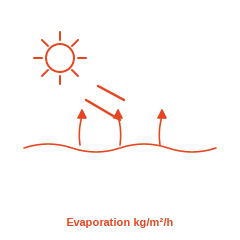
As felt at the slab surface, not at the site gate.
ACI 305R risk bands
| Below 0.5 kg/m²/h | Normal |
| 0.5 – 1.0 kg/m²/h | Precautions |
| Above 1.0 kg/m²/h | Cracking likely |
Evaporation rate
kg/m²/h
Immediate measures
The Menzel (1954) equation, in the metric restatement published by P. Uno (1998), is the arithmetic behind the ACI 305R / ACI 308 nomograph: E = 5.275×10⁻⁶ × [(Tₜ + 17.8)2.5 − RH·(Tₖ + 17.8)2.5] × (v + 4.02), with temperatures in °C, wind v in km/h, and E in kg/m²/h. Concrete temperature and wind dominate the result; air temperature and humidity matter less.
The risk bands come from ACI 305R. Two honest caveats travel with them: the nomograph family tends to overestimate above ~0.5 kg/m²/h (FHWA HRT-05-038: about 50% at 1.8), and low-bleed mixes, low w/c, silica fume, paving concrete, can crack at rates well below 1.0. Read the number as a screening trigger, then judge the mix.
Given: afternoon slab pour: concrete 35°C, air 35°C, humidity 20%, wind 25 km/h.
E = 5.275×10⁻⁶ × [(52.8)2.5 − 0.20×(52.8)2.5] × (25 + 4.02)
= 5.275×10⁻⁶ × 16,200 × 29.02 ≈ 2.5 kg/m²/h: well above 1.0. Reschedule to night, break the wind, and have fog nozzles and evaporation retarder on the deck before the first truck.
Cracks that form in the first hours, before the concrete gains strength, when the surface loses water faster than bleed water rises to replace it. The surface mortar shrinks while the interior does not, and the restrained skin tears into the classic map or parallel cracks. Wind, heat and low humidity are the drivers.
ACI 305R guidance, built on Menzel’s work: below about 0.5 kg/m²/h evaporation rarely outpaces bleeding; between 0.5 and 1.0 precautions are warranted; above 1.0 the loss typically exceeds bleed supply and cracking is likely without protection. It is a screening threshold, not a sharp line.
Treat it as a strong warning, not a precise value. FHWA notes the nomograph and its formulas tend to overestimate above roughly 0.5 kg/m²/h, by about 50% around 1.8, and are less reliable in very light winds. Low-bleed mixes (low w/c, silica fume) can crack well below 1.0, so judge the mix, not just the number.
Reduce the drivers or supply water: fog misting and monomolecular evaporation retarders, windbreaks and shade, placing in the cooler hours, damping the subgrade and forms, misting aggregates, chilled mixing water, and starting curing immediately after finishing. Never wait for bleed water to disappear before finishing flatwork.
Often used together with this calculator. Pick the next step in your design or QA loop.
This is the same calculator ConcreteInfo publishes on the main site. It runs in your browser, with no account and nothing to install.